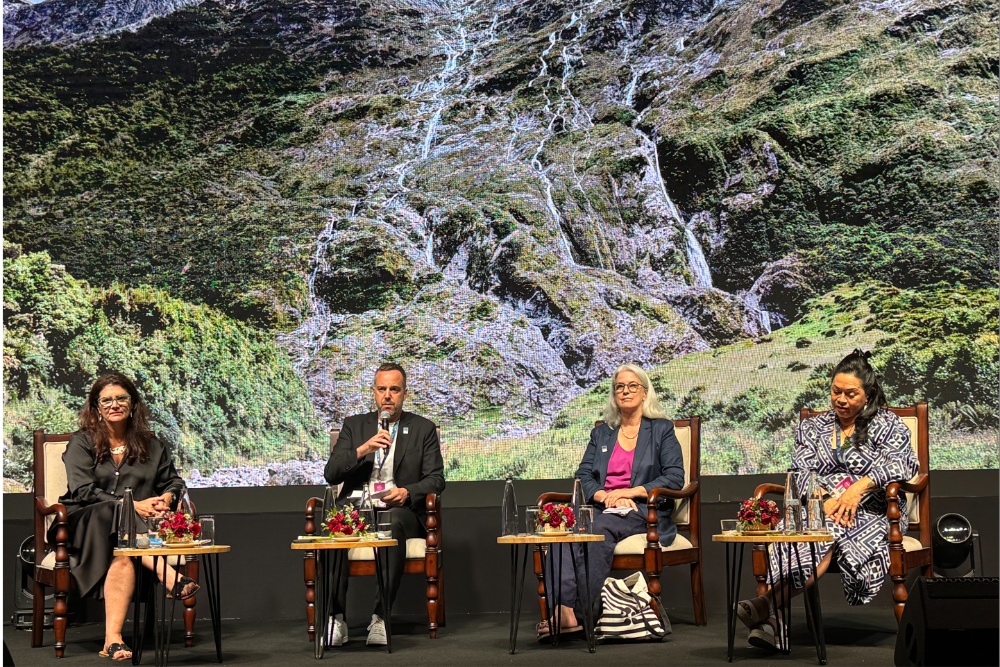
The New Zealand Film Commission is mounting a push into the Indian market, unveiling enhanced incentive packages while seeking to revitalize a largely dormant co-production treaty that has been utilized just once in 15 years. Speaking to Variety ahead of the WAVES Film Bazaar in Goa, NZFC CEO Annie Murray outlined significant changes to the country’s International New Zealand Screen Production Rebate that take effect Jan. 1, 2026. The modifications, which Murray said were informed by feedback from the Producers Guild of India, aim to position New Zealand as a more competitive destination for Indian productions of varying scales. “The new incentives really give us a more competitive edge than we had previously,” Murray explained. “We have aligned the threshold for minimum spend for both feature film, television, and streaming content to NZ$4 million [$2. 2 million].” The lowered threshold represents a substantial reduction from the previous NZ$15 million ($8. 4 million) minimum for feature films, bringing it in line with existing requirements for television and streaming projects. Murray indicated the change will enable small to medium-sized independent films to access the rebate, with particular interest from American and Indian producers. Additional modifications include the removal of the above-the-line cap on claims for roles such as director, producer, principal cast and screenwriter which Murray said was a barrier to some productions coming to New Zealand or returning to New Zealand. The threshold for accessing an additional 5% uplift has been reduced from NZ$30 million ($16. 8 million) to NZ$20 million ($11. 2 million), while the standalone post-production, digital and visual effects rebate now qualifies for a five percent uplift, bringing the total PDV rebate to 25% for qualifying productions. The commission is making its third visit to India in 12 months, leading a delegation of 13 New Zealand filmmakers alongside key executives including Philippa Mossman (head of international attraction and marketing), Chris Payne (deputy CEO and head of incentives and co-productions), and Te O Kahurangi Waaka (chief advisor Māori strategy). The delegation presented at the WAVES Film Bazaar Knowledge Series, emphasizing both co-production opportunities under the New Zealand-India Film Co-Production Treaty and inbound production possibilities. The treaty, signed approximately 15 years ago, has seen limited use beyond Pan Nalin’s “Beyond the Known World,” which was shot roughly a decade ago. “We realize it’s a diverse and fascinating country with multiple languages and regions that we really want to work with,” Murray said, noting interest in projects from Bollywood, Tollywood and other regional Indian cinema sectors. Recent Telugu-language productions “Kannappa” and “Game Changer” filmed in New Zealand locations without utilizing the co-production treaty structure, instead operating as inbound productions. Murray expressed hope that the enhanced incentive packages and sustained outreach will attract more projects of similar scale. Speaking at the Bazaar presentation, Payne detailed the financial mechanisms available through official co-productions. The structure requires balanced spend, creative contribution and financing between New Zealand and India, with qualifying projects able to access up to NZ$2. 5 million ($1. 4 million) in NZFC funding plus a 40% cash rebate on New Zealand expenditure. For productions not structured as official co-productions, the standard inbound production rebate offers 20% on qualifying spend, rising to 25% for projects exceeding NZ$20 million ($11. 2 million). The standalone PDV rebate requires a minimum spend of NZ$250, 000 ($140, 315). Te O Kahurangi Waaka emphasized the importance of cultural protocols and relationship-building in working with Māori communities, which she described as essential to production processes in New Zealand. She cited the integration of Māori dance and cultural elements in “Kannappa,” facilitated by Rotorua-based producer Piripi Curtis. “It’s important that we build those relationships based on can we get on with each other, do we actually like and believe in the kaupapa that you have,” Waaka said. Mossman outlined New Zealand’s production infrastructure, highlighting two major crew bases in Auckland and Wellington, with Wellington serving as home to companies associated with Peter Jackson and James Cameron. Smaller but significant production bases exist in Christchurch and Queenstown. “International producers and filmmakers tell us all the time about the extent to which the New Zealand workforce really wraps around the creative vision of producers and directors at all levels,” Mossman said. The commission maintains a specialized team providing services including location galleries, budget analysis through line producer consultations, production services coordination and immigration assistance. Murray revealed that direct flights between India and New Zealand are expected to commence by early 2027, eliminating current connection requirements through cities like Singapore. The NZFC’s India engagement builds on momentum from New Zealand’s largest-ever trade mission to India earlier in 2025. The current visit coincides with Robert Sarkies’ mining disaster drama “Pike River” having its Asian premiere at the International Film Festival of India (IFFI) as part of the Cinema of the World program. Murray referenced the enduring impact of the 2000 Hrithik Roshan-starrer “Kaho Naa. Pyaar Hai,” which was partially shot in New Zealand and resulted in a significant increase in Indian tourist footfall to the country. Filmmaker and choreographer Farah Khan recently visited Auckland for a screening of the film, which Murray attended. “Films are also our cultural ambassadors,” Murray said. “They do a wonderful job of connecting our countries in the same way that sport does.” Patricia Watson, executive director of Women in Film and Television New Zealand, is developing a co-production summit for 2026, building on similar initiatives previously conducted with Canada and Germany, to facilitate connections between Indian and New Zealand creatives.
https://variety.com/2025/film/markets-festivals/new-zealand-film-incentives-india-co-production-revival-1236589981/
New Zealand Sweetens Film Incentives, Eyes India Co-Production Revival – WAVES Film Bazaar

Byadmin
Nov 23, 2025