


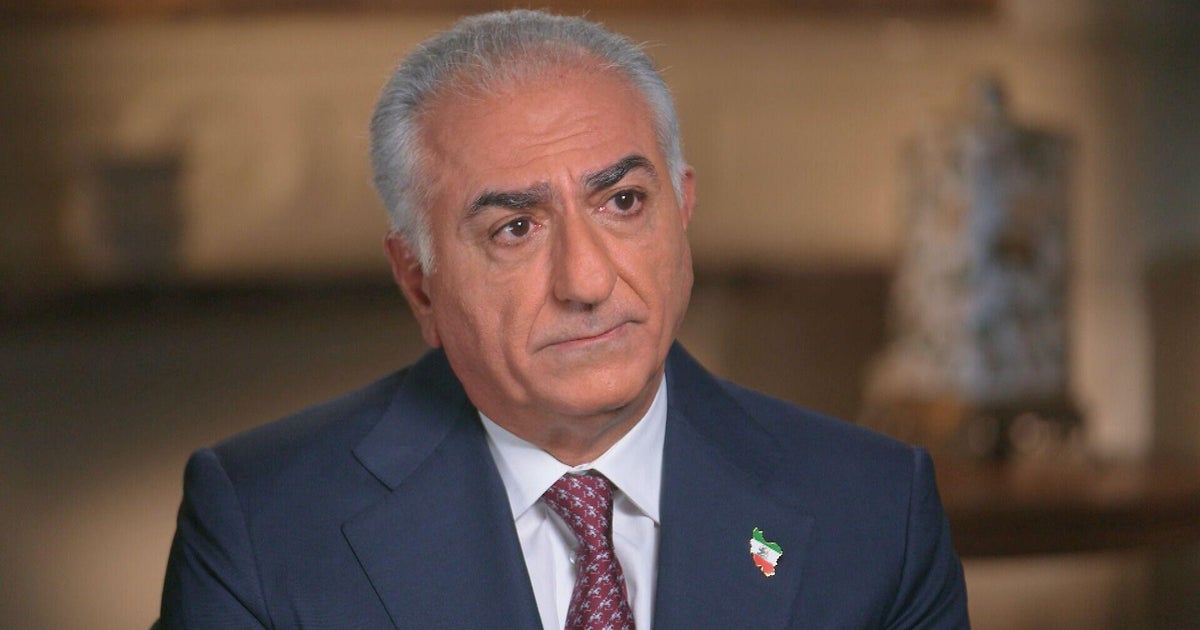
Tonight, the most prominent member of the Iranian opposition says he believes the Iranian regime is collapsing and he would like to lead a transition that makes Iran safe for the world.
Sixty-five-year-old Reza Pahlavi is the son of the former king, or shah, of Iran, who was deposed in 1979 by revolutionaries and hardline Islamic clerics. In that year of revolution, Pahlavi was 18 years old and living in Lubbock, Texas, where the U.S. Air Force was training him to be a fighter pilot. He was never able to go home. He has lived in exile for 47 years, mostly in the United States.
But tonight, he’s in Paris, where we asked him if he wants to be king, what Iran’s policy should be toward Israel, and nuclear weapons.
—
**The Death of Ayatollah Khamenei**
We started our interview with the news that the supreme leader of Iran, Ayatollah Khamenei, had been killed in the opening hours of the war.
**Reza Pahlavi:** “It is definitely a sort of earth-shattering event in the sense that when people identify the entire monstrosity of the regime that is depicted ultimately by the chief monster of these monsters, when he’s gone, one—the minute such a personality disappears, it’s like elation. It was like, ‘Oh, my God, it has finally occurred. Maybe this is it. This is our chance now.'”
**Scott Pelley:** “You call him a monster. What do you mean?”
**Reza Pahlavi:** “Well, I mean, ever since this regime has taken over, how many Iranians’ lives have been lost? I don’t think you can find an example of such a level of atrocity in the history of Iran or contemporary Iran than what has occurred under this regime. And this is all because of Ali Khamenei’s insistence and persistence to keep himself and his mafia regime in power at the expense of the Iranian people. I don’t know how else you can depict it other than being true monsters in the real sense of the word.”
—
**The January Uprising**
This past January, Iranians poured into the streets. Pahlavi urged them on, and hundreds of thousands marched. The regime gunned down an estimated 20,000 citizens. The massacre was a prelude to war.
**Scott Pelley:** “This is video overnight after the announcement of the death of the ayatollah in the city of Isfahan. What does that mean to you?”
**Reza Pahlavi:** “That means that finally, we are ready to go back to the streets—even though I have cautioned them that for now, you better take care of your own safety and stay at home. The time will come to go back on the streets. But then again, you see that despite that, people still are brave enough to say, ‘To hell with it. Because to us, it’s liberation. To us, it’s like a humanitarian intervention to protect lives that could otherwise continue to be lost.’ It gives the Iranian people a real opportunity now, when they see the end of this regime that was always bound to collapse, whether there was an intervention or not.”
“I want to make sure your audience understands that we were prepared to fight the fight. There was too much blood between us and this regime. We were committed to fight regardless of outside intervention. They’re thanking President Trump for actually standing on his word and acting upon it.”
—
**A Regime Near Collapse**
**Scott Pelley:** “Do you actually believe this regime could fall after almost 50 years?”
**Reza Pahlavi:** “Of course.”
Prince Reza Pahlavi told us he wants to lead Iran in a transition to democracy.
**Scott Pelley:** “You don’t want to be king?”
**Reza Pahlavi:** “I’m not running for office. I’m not.”
**Scott Pelley:** “Are you saying in this interview that you wouldn’t lead Iran?”
**Reza Pahlavi:** “That’s a different thing. They trust me as a transitional leader—not as the future king or future president or future whatever. I’m totally focused on my mission in life, which is to bring the country to a point where they can make that free choice. That would be enough for me—having said mission accomplished.”
—
**Iran’s Future Policy**
**Scott Pelley:** “You imagine peace with Israel?”
**Reza Pahlavi:** “Of course. In modern history, Iran actually gave refuge to Jews that were escaping the Nazis during the Second World War, giving them sanctuary in Iran. The strategic importance of having a partnership with Israel is critical.”
**Scott Pelley:** “What are the principles on which you would build a new Iran?”
**Reza Pahlavi:** “I think what today unites us are four core principles that I think are the subject of how we can work together towards that end.”
“Number one is Iran’s territorial integrity.”
“Number two is a clear separation of religion from state, which is a prerequisite for democracy. We paid the price understanding what it means to live under a religious dictatorship.”
“Number three is, of course, equality of all citizens under the law and individual liberties.”
“And most importantly, the process, or democratic process, to allow the people to elect and decide what the future system of governance should be.”
—
**On Nuclear Weapons**
**Scott Pelley:** “What would happen to the nuclear weapons program?”
**Reza Pahlavi:** “I think it should be totally dismantled. I don’t think Iran has any need to pursue the militarization or weaponizing of the nuclear program.”
—
**Pahlavi’s Father and Legacy**
Pahlavi’s father was the last king, Mohammad Reza Pahlavi. He was close to the United States but brutally suppressed opposition and showered friends with lavish wealth. In 1979, amid rising political tension, he left Iran. A hardline cleric, Ayatollah Khomeini, returned from exile to lead a revolution. Iranians blamed the U.S. for supporting the king. Revolutionaries overran the U.S. embassy in Tehran and held 52 Americans hostage for 444 days.
**Scott Pelley:** “Your father’s reign is remembered for repression and opulent wealth, and I wonder why you believe the people would welcome you now?”
**Reza Pahlavi:** “Well, you know, that’s perhaps one narrative. But when you look at a lot of people who were living during that era, they were telling me, ‘You know what? We recognize where we were and where we are now. Today, we want to be with you. We support you. We back you.’ And there were people who were in those so-called ‘prisons’—notorious or repressive—who were imprisoned under the previous regime.”
**Scott Pelley:** “People were killed in your father’s regime.”
**Reza Pahlavi:** “Look, my father left Iran voluntarily to avoid bloodshed. He said, ‘I’m a king. A king doesn’t build his throne on the blood of his own people. If the nation today wants me out, I will leave. I will not turn my guns on them.'”
**Scott Pelley:** “You have been out of the country for nearly 50 years. Why would the people want you?”
**Reza Pahlavi:** “If they thought that was an issue, I don’t think they’d be calling my name by the millions on the streets of Iran. Part of the reason people trust me is because they cannot associate me in any way or form to the revolution or to be part of this regime. The very same people who today are in the streets—the young kids who are getting shot and massacred by this regime—are a generation that turns to their parents and says, ‘What the hell were you thinking? What was that madness, to think that this Khomeini character is going to be our solution and our path to freedom? Look where we are now.'”
“But from the day I left, I never left Iran in my heart. Iran has been on my mind every single year of my life. Every single morning when I wake up, the first thing on my mind is Iran.”
—
**Relations with the United States**
Pahlavi told us he is in touch with the Trump administration and members of Congress.
**Scott Pelley:** “What is your message to President Trump?”
**Reza Pahlavi:** “My message to President Trump is that I’m here to echo and join millions of my compatriots inside and outside of Iran to thank him for having done and having the courage to do what is not easy but intervene. He will go down in the annals of Iranian history as the most celebrated foreign leader that changed the ballgame and changed the world as a result.”
**Scott Pelley:** “In January, President Trump said this about you, ‘He seems very nice. But I don’t know how he’d play within his own country. I don’t know whether or not his country would accept his leadership. And certainly, if they would, that would be fine with me.’ You don’t seem to have President Trump’s wholehearted support.”
**Reza Pahlavi:** “Well, first of all, I don’t think someone in my position should expect to have an official endorsement of a foreign government or a foreign leader. What I do know is that millions of Iranians inside and outside Iran are calling my name. They recognize in me a person uniquely placed to play a role of transitional leadership. Not running for office, because that’s not what I’m doing, but to be a bridge to that destiny.”
—
**Unrest in Iran**
Unrest has been building for months. Last June, U.S. and Israeli forces attacked Iran’s nuclear facilities. In 2022, one of the largest uprisings in the nearly 50-year history of the regime erupted.
Iran’s morality police arrested a 22-year-old woman, accusing her of failing to cover her hair. She was killed in custody, and crowds took to the streets to demand an end to the regime. Security forces killed more than 500, arrested 22,000, and blacked out the internet. Much of the population has been seething ever since.
**Scott Pelley:** “When you see the courage on the streets that we’re witnessing now, I wonder how that moves you?”
**Reza Pahlavi:** “I think it’s the ultimate definition of heroism. Do you remember that lone Chinese student in Tiananmen Square standing in front of that tank? I remember that image. Let me give you another visual that has been going viral on cyberspace—that firefighter who was carrying a wounded person shot on the streets just weeks ago, and then they shot him to death. That image exemplifies everything.”
**Scott Pelley:** “It’s a tremendous thing to witness.”
—
**Changing Loyalties in the Military**
Pahlavi told us there are units in the military and police who have signaled to him that they would turn on the hardline government.
He says many, but not all, troops could be given amnesty in a process of national reconciliation.
**Reza Pahlavi:** “And in fact, it will be a clear indication that this is the time for them to make a decision: Do you want to join this time with the people? Or do you want to stand with the sinking ship?”
—
**A Message to the Iranian People**
**Scott Pelley:** “It’s possible that this interview will penetrate the internet blackout. What do you say to the Iranian people?”
**Reza Pahlavi:** “Have faith in yourselves. You are a nation with an ancient civilization. I know how proud you are of your heritage, how important Iran is to you all. I always say to them, ‘You know what? I know you’re always hoping for a better future. What I would like you to start doing,’ and they have started to answer my call, ‘is instead of hoping, start believing that it can be done.'”
—
*Produced by Maria Gavrilovic, Nicole Young, and Michael Karzis.*
*Associate producers: Madeleine Carlisle, Kristin Steve, and Katie Kerbstat.*
*Broadcast associates: Michelle Karim and Georgia Rosenberg.*
*Edited by Peter M. Berman and Sean Kelly.*
*Assistant editor: Aisha Crespo.*
https://www.cbsnews.com/news/reza-pahlavi-future-of-iran-after-khamenei-death-60-minutes-transcript/